How to Invest $100 a Month in Index Funds (2025 Guide)
$20,484 — Value of $100/month after 10 years at 10% average annual return
$76,570 — Value of $100/month after 20 years at 10% average annual return
$197,393 — Value of $100/month after 30 years — you only contributed $36,000 of this
10.5% — Historical average annual S&P 500 return over 30 years through 2024
$1 — Minimum to start investing with Fidelity FZROX using fractional shares
Can $100 a Month Really Build Real Wealth?
The math says yes — definitively. Invest $100 every month starting at age 25 in an S&P 500 index fund at the 30-year historical average of ~10%, and you’ll have $197,393 by age 55. You contributed $36,000 of your own money. The other $161,393 is compound growth — money making money making money.
Priya, a 28-year-old software engineer in Pune, started a ₹8,000/month SIP (~$100) in a Nifty 50 index fund in 2019. Despite the 2020 market crash, her portfolio grew to over ₹6.5 lakhs by 2024. She describes it as ‘the best decision I made without really feeling it — the money left my account before I missed it.’
What $100/Month Grows to at Different Horizons
| Monthly Amount | 10 Years | 20 Years | 30 Years |
|---|---|---|---|
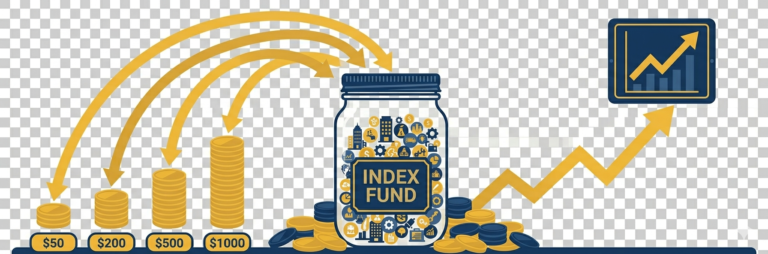
| $50/month | $10,242 | $38,284 | $98,700 |
| $100/month | $20,484 | $76,570 | $197,393 |
| $250/month | $51,210 | $191,424 | $493,482 |
| $500/month | $102,422 | $382,850 | $986,964 |
Your $100/Month Journey — Year by Year
How to Set Up Automatic $100/Month Investing
US investors: Open a Fidelity account → Accounts → Automatic Investments → select FZROX or VOO → set $100/month on your payday date. For tax-advantaged investing, max your Roth IRA first ($7,000/year limit in 2025 = $583/month). Indian investors: Set up a ₹8,000/month SIP via Groww, Zerodha Coin, or Paytm Money in a Nifty 50 index fund — HDFC Index Fund, UTI Nifty 50, or Nippon India Index all have expense ratios below 0.20%.
Critical trick: set the transfer date to your payday. Money that leaves your account before you see it doesn’t get spent. This is the single most effective personal finance habit.
Dollar-Cost Averaging: Why Monthly Investing Works
Dollar-cost averaging (DCA) means investing a fixed amount regardless of market conditions. When prices drop, your $100 buys more shares. When prices rise, it buys fewer. Over time this averages to a cost below the average price. Vanguard’s 2022 analysis of 58 global markets found DCA performed within 1.3% of lump-sum investing with significantly lower emotional stress for investors.
The One Rule: Never Stop During a Market Crash
The S&P 500 fell 18% in 2022. Investors who paused contributions locked in losses. Those who kept their $100/month contributions were buying more shares at discount prices. By the end of 2023, they had fully recovered and were ahead of anyone who stopped. Market drops are sales on shares. Keep buying every month no matter what.
See also: Best Index Funds for Beginners 2025 to choose your fund, and S&P 500 vs Total Market for the comparison.
Frequently Asked Questions
What if I can only afford $50/month to start?
Start with $50. The habit matters far more than the amount when you’re starting out. $50/month for 30 years at 10% still grows to ~$99,000. Increase contributions whenever your income grows.
Roth IRA or regular brokerage account?
Roth IRA first if you’re eligible (US investors under income limits). Your money grows completely tax-free forever. Once you max the $7,000 annual limit, use a regular taxable brokerage account for additional investing.
How do I invest $100/month in India?
Set up a ₹8,000/month SIP in a Nifty 50 index mutual fund via Groww, Zerodha Coin, or INDmoney. Best options: HDFC Index Fund Nifty 50 Plan, UTI Nifty 50, Nippon India Index Fund — all below 0.20% expense ratio.
Should I pay off debt before investing?
Pay off high-interest debt first (above 7%) — guaranteed 20% return on eliminating credit card debt beats expected 10% market return. For low-interest debt under 5%, invest and pay debt simultaneously.
What if my income drops and I can’t invest $100?
Reduce to whatever you can — even $10 — but don’t stop entirely. The habit is more valuable than the amount. Stopping and restarting costs you more in lost compounding than maintaining contributions at a lower amount.
Is $100/month enough to retire on?
Not alone for most people, but a powerful starting point. Most people increase contributions as their salary grows. Increasing to just $300/month at some point transforms the 30-year outcome from $197K to nearly $600K.
Start Today, Not Someday
Someone starting at 25 vs 35 with the same $100/month ends up with $197K vs $76K at age 55 — a $121,000 difference from just 10 years of delay. Set up your automatic investment this week. Future you will be genuinely grateful.