
How to Invest in Index Funds: Step-by-Step Beginner’s Guide for 2026
Investing in index funds is one of the best financial decisions you can make — and the actual process is simpler than most people expect. This guide walks you through every step, from opening your account to making your first purchase to setting up automatic monthly investments. If you follow these steps, you’ll be invested in a globally diversified portfolio by the end of today.
Step 1: Choose Your Account Type
Before choosing a fund, choose the right account type. This decision has enormous tax implications that compound over decades.
Roth IRA — Best Starting Point for Most Beginners
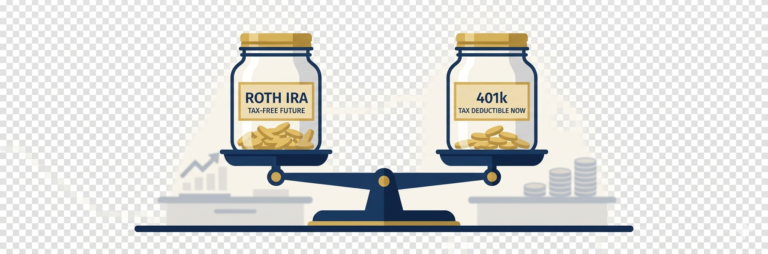
A Roth IRA allows your investments to grow completely tax-free and be withdrawn tax-free in retirement. You contribute after-tax dollars, but pay zero taxes on the growth — ever. 2026 contribution limit: $7,000/year ($8,000 if age 50+). Income limits apply (single filers begin phasing out at $150,000 MAGI). For most people in their 20s–40s who expect their income to grow, the Roth IRA is the most powerful investment account available.
Traditional IRA
Contributions may be tax-deductible, reducing your current-year tax bill. Withdrawals in retirement are taxed as income. Better choice if you expect to be in a lower tax bracket in retirement than you are now.
401(k) — Use to Capture Employer Match First
If your employer offers a 401(k) match, contribute at least enough to capture the full match before opening an IRA. A 50% match on 6% of salary is an instant 50% return on that money — no investment can beat that. See our guide on Roth IRA vs 401k for the complete decision framework.
Taxable Brokerage Account
No tax advantages, but no contribution limits and no restrictions on withdrawals. After maxing tax-advantaged accounts, a taxable brokerage account is the right overflow vehicle for additional investing.
Step 2: Choose Your Brokerage
For index fund investors, any of the big three brokerages — Fidelity, Vanguard, or Schwab — is an excellent choice. All offer commission-free index fund investing with no account minimums. See our detailed comparison: Vanguard vs Fidelity vs Schwab.
Quickest path for total beginners: Fidelity. Modern app, zero-fee funds (FZROX), no minimums, 24/7 customer service.
Step 3: Open Your Account
The account opening process is entirely online and takes 10–15 minutes. You’ll need: Social Security Number, a US bank account for funding, your employer’s name and address, and a government-issued ID (driver’s license or passport). Go to fidelity.com, vanguard.com, or schwab.com and click “Open an Account.” Follow the prompts for the account type you chose.
Step 4: Fund Your Account
Link your bank account through the electronic bank transfer process. Enter your bank’s routing number and your account number (found on a check or in your banking app). Transfer your initial investment — even $50 works. Transfers typically take 1–3 business days to settle. Some brokerages (Fidelity, Schwab) allow you to start buying immediately using provisional credit before the transfer clears.
Step 5: Choose and Buy Your Fund
Search for your chosen fund by ticker symbol. For Fidelity account holders: FZROX (total market, 0% expense ratio). For any brokerage: VOO (S&P 500 Vanguard ETF), VTI (total market Vanguard ETF), or SWPPX at Schwab. See the full recommendations in best index funds for beginners.
Click “Buy” or “Trade.” Enter the dollar amount you want to invest (most platforms offer fractional share buying, so you don’t need to invest in exact share price multiples). Review and confirm. You are now an investor.
Step 6: Set Up Automatic Monthly Contributions
This is the most important step for long-term success. Automatic investing removes the temptation to time the market, implements dollar cost averaging automatically, and builds the habit of investing before you can spend the money. Set up an automatic monthly transfer from your bank to your brokerage and automatic investment into your chosen fund. Even $100/month invested consistently for 30 years at historical returns grows to approximately $226,000.
Step 7: Set It and (Mostly) Forget It
Check your portfolio no more than quarterly. Market fluctuations between checks are noise. Your job now is to continue contributing consistently, increase contributions as your income grows, and not sell during market downturns. The biggest risk to your investment outcome is not market volatility — it’s behavioral: selling at the wrong time or stopping contributions during difficult markets.
Common Beginner Mistakes to Avoid
- Waiting for the “right time” to invest — time in the market always beats timing the market
- Checking your portfolio daily — creates anxiety without adding value
- Selling during market downturns — every major decline in history was followed by full recovery
- Investing before having an emergency fund — keep 3-6 months of expenses in a high-yield savings account first
FAQ
Can I lose all my money in an index fund?
An S&P 500 or total market index fund going to zero would require every major US company to simultaneously go bankrupt — effectively impossible in a functioning economy. Index funds can and do lose 20-40% in recessions, but they have recovered from every decline in history and gone on to new highs.
How long should I keep money in index funds?
Index funds are long-term investments — ideally 10+ years. The longer your time horizon, the more the short-term volatility smooths out. Over any 20-year period in US stock market history, returns have been positive.