
S&P 500 Index Fund: What It Is, How It Works, and Should You Invest?
The S&P 500 is the most referenced financial benchmark in the world — and investing in an S&P 500 index fund is one of the most proven long-term wealth-building strategies available. This guide explains exactly what the S&P 500 is, how S&P 500 index funds work, what returns to realistically expect, and which specific fund to choose.
What Is the S&P 500?
The S&P 500 (Standard & Poor’s 500) is a stock market index representing the 500 largest publicly traded US companies by market capitalization. It includes companies like Apple, Microsoft, Amazon, Nvidia, Google, Meta, Berkshire Hathaway, and 494 others. Together, these 500 companies represent approximately 80% of the total US stock market value — making the S&P 500 a reasonable proxy for the overall health of the US economy.
The index is maintained by S&P Global. Companies are added and removed periodically based on size, liquidity, and other criteria. When a company grows large enough (currently requires ~$14+ billion market cap), it may be added. When a company shrinks or is acquired, it’s removed.
How an S&P 500 Index Fund Works
An S&P 500 index fund buys and holds all 500 companies in the index in proportion to their market cap. Larger companies (Apple, Microsoft) represent larger positions; smaller S&P 500 companies represent smaller slices. The fund simply mirrors the index — no analyst team, no stock picking, no predictions about which companies will outperform.
When you invest $1,000 in an S&P 500 index fund, you instantly own a tiny fraction of all 500 companies. If the S&P 500 goes up 15% this year, your investment goes up 15% (minus the tiny expense ratio). If it goes down 20%, your investment goes down 20%. You’re riding the overall market, not betting on individual winners.
S&P 500 Historical Returns
| Time Period | Annualized Return |
|---|---|
| Last 10 years (2015–2025) | ~13.2%/year |
| Last 20 years (2005–2025) | ~10.4%/year |
| Last 30 years (1995–2025) | ~10.7%/year |
| Since 1957 inception | ~10.5%/year average |
These returns include dividends reinvested and are nominal (not inflation-adjusted). Inflation-adjusted real returns average approximately 7%/year over the long term.
Best S&P 500 Index Funds in 2026
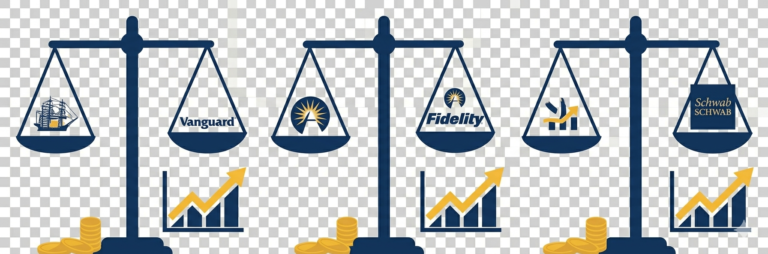
Vanguard S&P 500 ETF (VOO) — 0.03% expense ratio
The gold standard S&P 500 fund. One of the largest ETFs in the world by assets. Available at any brokerage. Fractional shares available at most platforms. The Vanguard investor-owned structure keeps costs structurally minimized.
Fidelity 500 Index Fund (FXAIX) — 0.015% expense ratio
Slightly cheaper than VOO. Mutual fund format (not ETF) — no bid/ask spread, prices once daily at market close. Only available at Fidelity. Excellent choice for Fidelity account holders who prefer mutual fund structure.
Schwab S&P 500 Index Fund (SWPPX) — 0.02% expense ratio
No minimum investment. Excellent low-cost option for Schwab account holders. Mutual fund format.
iShares Core S&P 500 ETF (IVV) — 0.03% expense ratio
Managed by BlackRock. Available at all brokerages. Equivalent to VOO in terms of holdings and performance — useful if you’re investing through a platform that doesn’t offer Vanguard’s own funds cheaply.
S&P 500 vs Total Market Index: What’s the Difference?
A total US stock market fund (like FZROX or VTI) includes the S&P 500’s 500 large companies plus thousands of mid-cap and small-cap companies. The S&P 500 represents about 80% of total US market value, so the two are highly correlated and perform similarly over time. For most beginners, either choice is equally excellent. The total market fund provides slightly more diversification; the S&P 500 is more established and widely discussed.
See our full recommendations in best index funds for beginners and our step-by-step guide to how to invest in index funds.
Should You Invest in the S&P 500 Right Now?
The question “is now a good time to invest” has the same answer regardless of when you ask it: for long-term investors with a 10+ year horizon, the best time to invest is consistently, regardless of current market levels. Market timing studies consistently show that even perfect market timing (always buying at bottoms) barely outperforms consistent regular investing — and imperfect timing dramatically underperforms it. Invest consistently, reinvest dividends, and let compounding do the work.
FAQ
How often does the S&P 500 go down?
The S&P 500 experiences a 10%+ correction roughly every 1–2 years, a 20%+ bear market roughly every 3–5 years, and a 30%+ crash roughly every 10–15 years. Every single one of these has been followed by full recovery and new highs. This history is why long-term investing, not market timing, is the appropriate strategy.
Do S&P 500 funds pay dividends?
Yes. The S&P 500 pays dividends currently yielding approximately 1.3–1.5% annually. In mutual fund format, dividends are automatically reinvested. In ETF format, dividends are paid as cash distributions and can be set to automatically reinvest.