S&P 500 vs Total Market Index Fund: Which Should You Choose?
500 — Companies in the S&P 500 index — large-cap US companies only
3,700+ — Companies in the total US stock market index including small and mid-cap
82% — Percentage of total US market value represented by the S&P 500
0.1% — Annual performance difference over 30 years — S&P 500 leads by just 0.1%/yr
0.03% — Annual expense ratio of both VOO and VTI — effectively identical cost
The Honest Answer: They’re Almost Identical
Over the past 30 years, the S&P 500 and the total US stock market have performed within 0.1% of each other annually. The VOO vs VTI debate is largely academic for long-term investors. Both are excellent, both cost nearly nothing, and both will likely make you significantly wealthier over decades.
That said, ‘almost the same’ is not ‘exactly the same’ — understanding the real differences helps you make a deliberate choice that you’ll stick with confidently.
What’s Actually in Each Fund
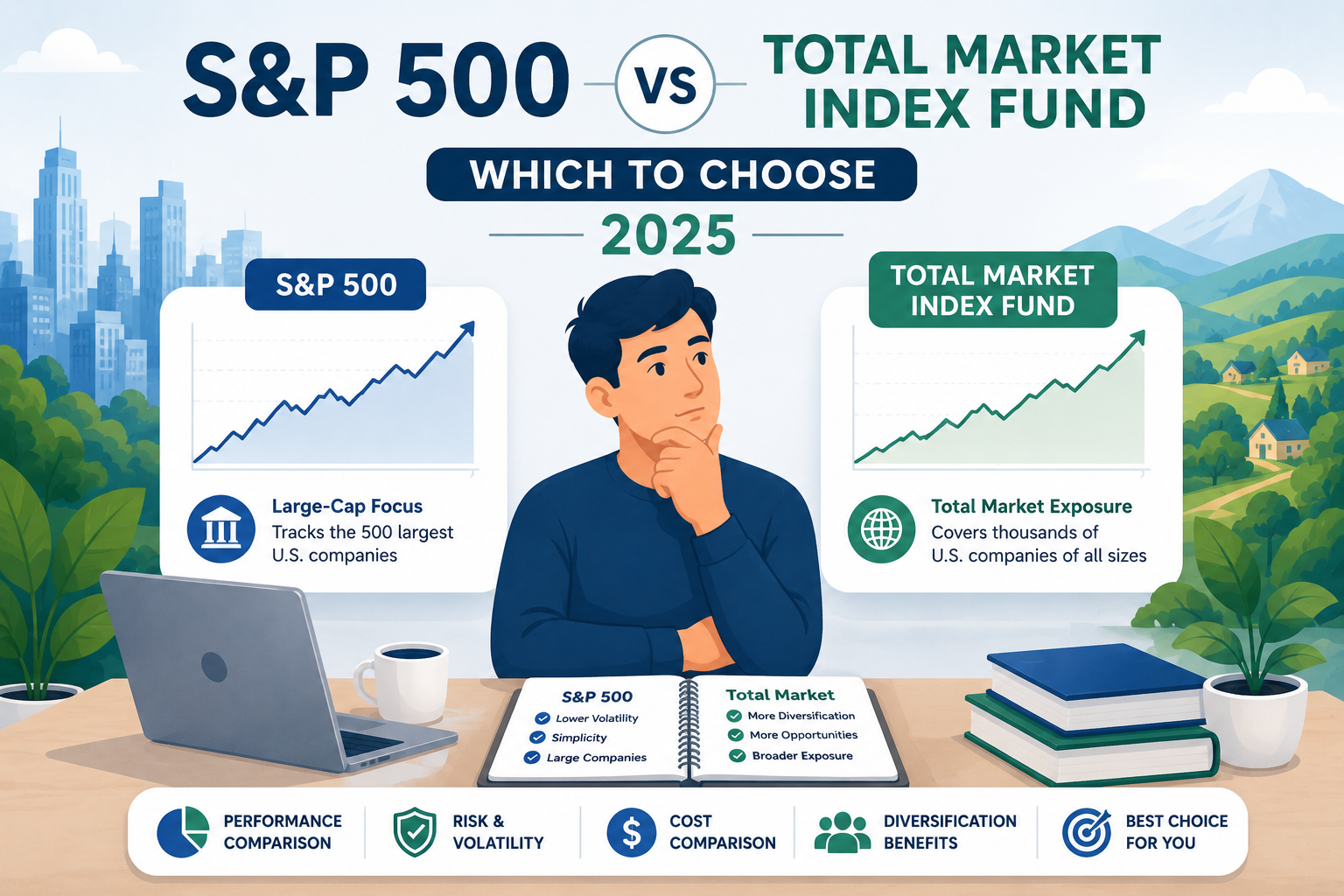
An S&P 500 fund tracks 500 of the largest US companies selected by the S&P committee — all large-cap. The top 10 holdings (Apple, Microsoft, NVIDIA, Amazon, Alphabet, Meta, Berkshire, Tesla, etc.) make up roughly 32% of the entire index.
A total market fund tracks the entire investable US stock market — about 3,700 companies. It includes all S&P 500 companies plus approximately 3,200 additional small-cap and mid-cap companies. Those extra companies represent about 18% of total market value.
Historical Performance Comparison
| Period | S&P 500 | Total Market | Difference |
|---|---|---|---|
| 1 year (2024) | +25.0% | +23.8% | S&P 500 leads by 1.2% |
| 5 years (2020–2024) | +14.5%/yr | +13.9%/yr | S&P 500 leads by 0.6%/yr |
| 10 years (2015–2024) | +12.9%/yr | +12.7%/yr | S&P 500 leads by 0.2%/yr |
| 30 years (1994–2024) | +10.7%/yr | +10.6%/yr | S&P 500 leads by 0.1%/yr |
When to Choose the Total Market Fund
Total market gives you exposure to small and mid-cap companies. Research published in the Journal of Finance (1926–2012 data) shows small-cap stocks returned about 2% more annually than large-cap stocks over the very long term — the ‘small-cap premium.’ If you’re investing for 30+ years and believe in complete market diversification across all company sizes, total market is the more complete bet on the entire US economy.
When to Choose the S&P 500 Fund
S&P 500 makes sense if: it’s the only quality option available in your 401(k), you prefer tracking a widely-reported benchmark, you’re at Fidelity where FXAIX (0.015%) is marginally cheaper than their total market option, or you want slightly lower short-term volatility since the S&P 500 excludes more volatile small-caps.
See also: Best Index Funds for Beginners 2025 | How to Invest $100 a Month in Index Funds
Frequently Asked Questions
VTI or VOO — which is better for a 20-year investment?
Both are excellent. Performance difference over 20 years will likely be under 0.5%/year total. JL Collins (author of The Simple Path to Wealth) recommends VTI for its broader diversification. Pick either one and commit to it.
Should I own both S&P 500 and total market at the same time?
It’s largely redundant — S&P 500 is already 82% of the total market by value. Owning both just doubles your large-cap exposure with slightly added small/mid-cap. Pick one for simplicity and clarity.
Should I add international index funds to my portfolio?
Many financial advisors recommend 20–40% international exposure (VXUS or FTIHX). US stocks have dominated the past 15 years but this wasn’t always true and may not continue. International diversification reduces country-specific risk.
Does the ‘total market’ include international stocks?
No — ‘total market’ typically means the total US stock market only. For international, you need a separate fund: VXUS (Vanguard Total International) or FZILX (Fidelity ZERO International Index Fund).
Should I switch from my S&P 500 fund to a total market fund?
If you’re in a taxable account, switching triggers a taxable event not worth the tiny theoretical benefit. Better approach: keep your S&P 500 fund and direct new contributions toward a total market fund to gradually add small/mid-cap exposure going forward.
Which is more stable during market crashes?
S&P 500 is marginally more stable. In 2022: VOO fell 18.1%, VTI fell 19.5%. Both recovered fully in 2023. Neither is a safe short-term investment — both are long-term wealth builders.
The Real Bottom Line
Stop agonizing over this choice. Both VOO and VTI, both FXAIX and FZROX are excellent funds. Both cost near-zero. Both will likely make you wealthy over decades. The cost of waiting to decide is compounding you will never recover. Pick one today and start investing. You can always adjust later.