Dollar Cost Averaging With Index Funds: The Beginner’s Strategy
Dollar cost averaging — investing a fixed amount at regular intervals regardless of market conditions — is one of the most powerful and psychologically effective strategies for building long-term wealth. Combined with index funds, it creates an almost autopilot path to financial independence that removes emotion, eliminates market timing stress, and consistently produces excellent results over time.
Disclaimer: This content is for educational purposes only and does not constitute financial advice.
What is Dollar Cost Averaging?
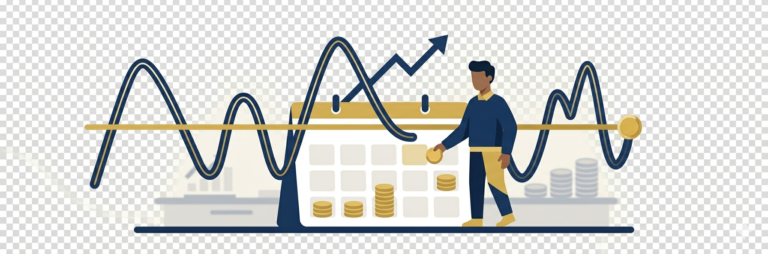
Dollar cost averaging (DCA) means investing a fixed dollar amount — say $200 — into your chosen index fund on a set schedule, such as the first of every month. When the market is up and share prices are high, your $200 buys fewer shares. When the market is down and prices are lower, your $200 buys more shares. Over time, this automatic adjustment means you buy more when prices are low and less when they are high — the opposite of emotional investing behavior. Read What is an Index Fund? for foundational context.
Why Dollar Cost Averaging Works
DCA works for three main reasons. First, it eliminates the impossible task of timing the market. Nobody — not professional investors, not hedge funds, not Nobel Prize winners — can consistently predict when the market will go up or down. DCA removes this problem entirely by investing at regular intervals regardless of conditions.
Second, DCA turns market downturns into opportunities. When the market drops 20%, most investors panic and stop investing or sell. DCA investors keep buying — and accumulate more shares at lower prices. When the market recovers, those low-price shares produce outsized gains.
Third, DCA creates discipline through automation. Once set up, it requires no ongoing decision-making. The investment happens automatically, removing the psychological friction that causes most people to procrastinate or stop investing during volatility.
DCA vs Lump Sum Investing
Academic research shows that lump sum investing — investing all available money immediately — outperforms DCA about 66% of the time in markets with an upward long-term trend. This makes sense: money invested earlier spends more time in the market earning returns. However, for investors without a large lump sum (most people), DCA is the only practical option. And for investors prone to anxiety about market timing, DCA’s psychological benefits may outweigh the theoretical performance difference.
How to Set Up Dollar Cost Averaging
Setting up DCA with index funds is straightforward. At your brokerage (Fidelity, Vanguard, or Schwab), find the automatic investment or recurring investment feature. Set the frequency — monthly is most common and easiest to align with paydays. Set the amount — whatever you can consistently contribute. Choose your target fund. Set a start date and let it run. See our guide How to Start Investing in Index Funds for account setup guidance.
What Amount Should You Invest Monthly?
The right amount is whatever you can invest consistently without financial strain. Starting with $50 per month is infinitely better than waiting until you can invest $500. Increase the amount whenever your income grows. A common guideline is to aim for saving and investing 15 to 20% of your gross income, but starting small is always better than not starting.
DCA During Market Downturns
The hardest part of DCA is continuing to invest when the market is falling. This is also the most important part. Market downturns are not disasters for long-term DCA investors — they are sales. Every month you invest during a bear market, you are buying shares at a discount. History shows that every market downturn has eventually been followed by a full recovery and new highs.
Real Example: DCA Over 20 Years
Investing $300 per month in a total stock market index fund starting in 2004. Over 20 years (including the 2008 crash, COVID crash, and multiple corrections), total contributions: $72,000. Estimated portfolio value (at approximately 8% average annual return): approximately $177,000. Every dollar worked harder because DCA kept buying through every downturn.
Conclusion
Dollar cost averaging with index funds is the strategy most financial experts recommend for most individual investors. It is simple, automatic, psychologically sound, and historically effective. Set it up, automate it, and let compound growth do the work. Continue with Best Index Funds for Beginners and The Three Fund Portfolio for Beginners.