
Best Index Funds for Beginners in 2026: Top Picks to Start Investing
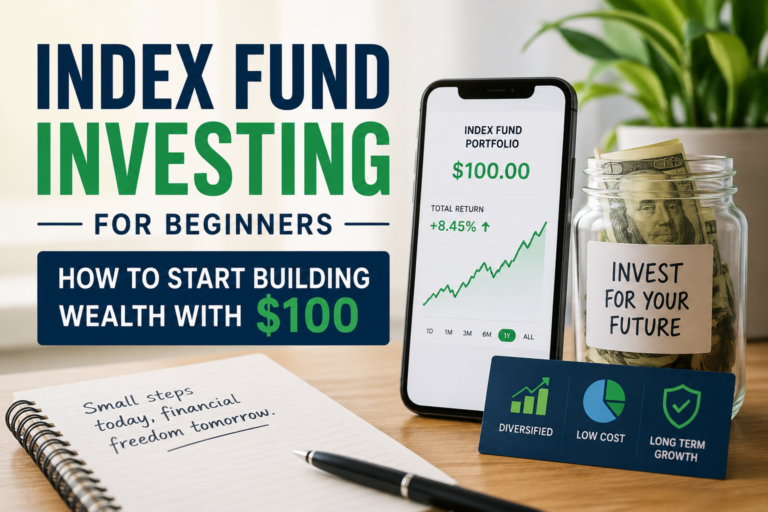
Index funds are the most reliable wealth-building tool available to ordinary investors — and in 2026, you can start with as little as $1. This guide cuts through the overwhelming number of options to give you the specific funds most beginners should buy first, why each works, and exactly how to get started today.
What Is an Index Fund and Why Should Beginners Care?
An index fund is a type of investment fund that tracks a market index — a pre-defined list of stocks or bonds. Instead of trying to pick winners, it buys every stock in the index proportionally. An S&P 500 index fund owns all 500 largest US companies. When they collectively do well, your fund goes up. Simple, diversified, and requiring no ongoing decisions from you.
The genius is what it eliminates: expensive fund managers, high trading costs, and the psychological trap of trying to time the market. Over 90% of actively managed funds underperform their benchmark index over 15-20 years after fees. Index funds simply own the index — and charge almost nothing for doing so.
The 5 Best Index Funds for Beginners in 2026
1. Fidelity ZERO Total Market Index Fund (FZROX) — Best: Absolute Zero Cost
Expense ratio: 0.00% — literally free to own. FZROX tracks the total US stock market, giving you exposure to over 2,500 companies including large, mid, and small caps. Available only at Fidelity with no minimum investment. For a beginner who wants maximum diversification at zero cost, this is the starting recommendation.
2. Vanguard S&P 500 ETF (VOO) — Best: Most Trusted
Expense ratio: 0.03%. One of the most widely held investments in the world. Tracks the S&P 500 — the 500 largest US companies representing about 80% of total US stock market value. Vanguard’s investor-owned structure keeps costs structurally low. Available in fractional shares at most major brokerages.
3. Schwab S&P 500 Index Fund (SWPPX) — Best: No Minimum
Expense ratio: 0.02%. No minimum investment — perfect for starting with $50 or $100. One of the lowest expense ratios for an S&P 500 fund anywhere. Excellent for Schwab account holders.
4. Vanguard Total Stock Market ETF (VTI) — Best: Broadest US Coverage
Expense ratio: 0.03%. Covers 3,700+ US companies — everything from mega-caps to small-cap growth companies. More comprehensive than S&P 500. Available in fractional shares. Excellent choice if you want to own essentially the entire US stock market.
5. Fidelity ZERO International Fund (FZILX) — Best: Global Diversification at Zero Cost
Expense ratio: 0.00%. Covers developed and emerging market stocks outside the US. Adding international exposure alongside a US fund reduces dependence on any single country’s economy. Financial advisors generally recommend 20-40% international allocation for long-term investors.
How to Choose Between These Funds
For most beginners, the decision is simple: start with one broad US market fund (FZROX, VOO, SWPPX, or VTI) and own it consistently for decades. The difference in performance between these four options over 30 years is negligible compared to the impact of consistent investing. Don’t overthink the selection — the biggest mistake is waiting for the “perfect” fund choice instead of starting.
Once you have $5,000–$10,000 in a US fund, consider adding FZILX or Vanguard’s VXUS for international exposure. A simple two-fund portfolio (total US market + total international) gives you exposure to thousands of companies in dozens of countries — that’s all the diversification most investors need.
How to Actually Buy These Funds
See our step-by-step walkthrough in how to invest in index funds. The short version: open a Roth IRA or brokerage account at Fidelity, Vanguard, or Schwab — see our comparison in Vanguard vs Fidelity vs Schwab — fund it with your initial investment, search the fund by ticker symbol, and buy. The entire process takes about 20 minutes.
What to Avoid as a Beginner
- High expense ratio funds: Any fund charging over 0.20%/year is eating your returns unnecessarily
- Thematic or sector ETFs: “AI ETF,” “clean energy ETF,” “metaverse ETF” — narrow bets, not diversified investing
- Leveraged ETFs: These reset daily and destroy value over time for buy-and-hold investors
- Individual stocks before funds: Build your index fund foundation first; individual stocks are additions, not substitutions
FAQ
How much money do I need to start investing in index funds?
With Fidelity (FZROX) or Schwab (SWPPX): $1. With Vanguard ETFs: the price of one share (VOO trades around $500, but many platforms offer fractional shares). There’s genuinely no minimum barrier at major brokerages in 2026.
Should I invest in one fund or multiple?
Start with one. A single broad market index fund (like FZROX or VTI) gives you instant diversification across thousands of companies. Adding more funds adds complexity without meaningfully adding diversification for most beginners.
Ready to Start Investing?
Open a free brokerage account and buy your first index fund today.