
Flat illustration: young person viewing upward-trending investment chart on tablet, warm blues and greens, clean modern financial style, hopeful and approachable mood, no text on screen.
0.03% — Annual expense ratio of Vanguard VOO — just $3/year per $10,000 invested
92% — Actively managed funds underperforming S&P 500 over 15 years (SPIVA 2023)
10.5% — Historical average annual S&P 500 return over the past 30 years through 2024
$1 — Minimum to start investing in Fidelity FZROX with fractional shares
$0 — Annual expense ratio for Fidelity ZERO Total Market Fund (FZROX)
What Is an Index Fund — in Plain English
An index fund is a basket of stocks that automatically mirrors a market index like the S&P 500. Buy one share of VOO (Vanguard S&P 500 ETF) and you instantly own tiny pieces of Apple, Microsoft, NVIDIA, Amazon, and 496 other major US companies. No stock-picking, no research required.
Here’s why this matters: SPIVA’s 2023 scorecard found 92% of actively managed funds underperform the S&P 500 over 15 years. Professional fund managers with million-dollar research budgets consistently lose to a simple index fund that just buys everything. Warren Buffett has publicly recommended index funds for individual investors more than a dozen times.
Three properties make index funds perfect for beginners: ultra-low cost (expense ratios as low as 0%), instant diversification (hundreds of companies in one purchase), and no ongoing management needed (the fund automatically rebalances itself).
The Best Index Funds for Beginners in 2025
Why Expense Ratio Is the Most Important Number
| Fund | Expense Ratio | Annual Cost on $10K | $10K after 30 yrs (10%) |
|---|---|---|---|
| Vanguard VOO | 0.03% | $3 | $174,490 |
| Fidelity FZROX | 0.00% | $0 | $174,491 |
| Typical active fund | 0.75% | $75 | $155,220 |
| Expensive active fund | 1.50% | $150 | $132,877 |
Which Brokerage Is Best for Beginners?
Fidelity wins for most beginners in 2025: zero account minimums, fractional shares on every ETF (buy $5 of VOO instead of ~$510), no trading commissions, and FZROX at 0% expense ratio. Their app is significantly more user-friendly than Vanguard’s. Vanguard is excellent if you’re committed long-term. Schwab is a solid choice, especially if you want combined investing and banking.
How to Buy Your First Index Fund (Step by Step)
- Open a Fidelity account at fidelity.com — takes 10 minutes
- Transfer money from your bank (1–3 business days to clear)
- Search for ticker: FZROX or VOO
- Click Buy, enter a dollar amount (Fidelity allows dollar-based purchases)
- Select Market order and confirm — you are now an investor
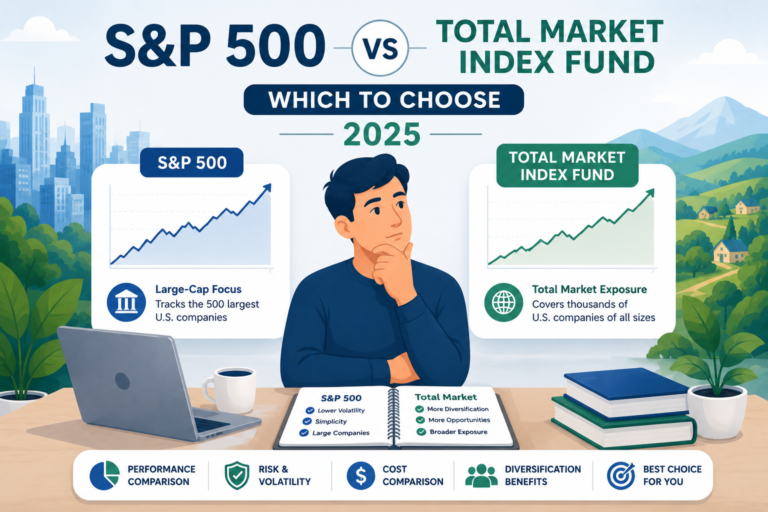
For building a monthly habit: How to Invest $100 a Month in Index Funds. For comparing the two main options: S&P 500 vs Total Market Index Fund.
Frequently Asked Questions
Can I lose all my money in an index fund?
No — you own hundreds of companies so you can’t lose everything. Even in the worst crashes (2008: -37%, 2022: -18%), the S&P 500 fully recovered. Over any 15-year period in US history, markets have been positive.
Lump sum investment or monthly contributions?
Vanguard research (2012) shows lump-sum beats dollar-cost averaging about 67% of the time over 10 years. But monthly contributions are psychologically easier and still excellent. Best strategy = the one you’ll actually stick to.
What’s the difference between an ETF and a mutual fund index?
ETFs trade during market hours like stocks; mutual funds price once daily. Both track the same index with essentially identical returns. ETFs are slightly more tax-efficient; mutual funds allow easier fractional investing.
How many index funds do I actually need?
Just one is enough — a total US market or S&P 500 fund. Warren Buffett recommends simplicity. A three-fund portfolio (US + international + bonds) adds diversification but one quality fund is a complete starting portfolio.
Can I invest in US index funds from India?
Yes — through the Liberalized Remittance Scheme (LRS, up to $250,000/year). Platforms like INDmoney, Vested, and Groww let Indian residents buy US ETFs like VOO and VTI directly. For domestic India exposure, Nifty 50 SIPs via Zerodha or Groww are excellent low-cost alternatives.
What taxes do I pay on index fund gains?
US: long-term capital gains tax (0%, 15%, or 20% depending on income) on holdings over 1 year. In a Roth IRA, gains are completely tax-free. India: LTCG at 12.5% on equity mutual fund gains above ₹1.25 lakh/year (as of 2024).
Stop Waiting — Start Small Today
The most expensive investing mistake is waiting. Open a Fidelity account today, invest whatever you can afford (even $10), and set up monthly automatic contributions. The habit matters infinitely more than the starting amount. Every month you delay is compounding you never get back.