How Much Money Do You Need to Start Investing?
This is general information, not personalized financial advice. The idea that you need thousands of dollars to start investing is left over from a time when brokers charged high trading commissions and required whole shares. Neither of those is true anymore.
The actual minimum: often $0
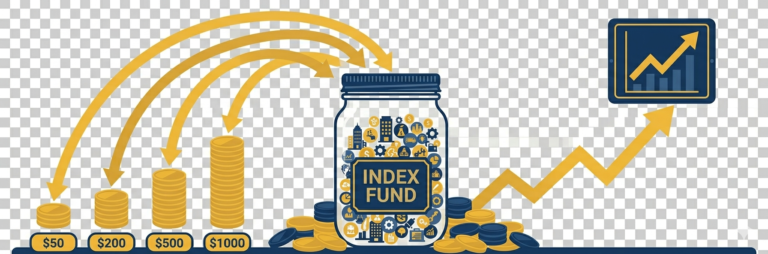
Most major brokerages, including Fidelity, Schwab, and Vanguard, have eliminated account minimums and commission fees for online stock and ETF trades. You can open a brokerage account with no money down and start with whatever amount you have available, even $25 or $50.
Fractional shares changed the math
Historically, buying a single share of an expensive stock or a broad-market index fund could require hundreds of dollars. Most major brokers now support fractional share purchases, letting you invest a fixed dollar amount, like $20, and receive a proportional slice of a share regardless of its full price. This is what actually removed the old dollar barrier to entry, more than anything else.
The amount matters less than the habit
A more useful question than “how much do I need” is “how much can I contribute consistently.” Automating a fixed contribution from every paycheck, even a small one, builds the habit and takes advantage of dollar-cost averaging: buying at both high and low prices over time rather than trying to guess when to invest a lump sum. A consistent $50 a month typically builds more wealth over a decade than a single $500 deposit followed by years of inaction.
One thing to check before you start
Before opening a taxable brokerage account, see whether your employer offers a 401(k) match, since that is essentially free money and generally worth capturing before directing new money elsewhere. After that, the right account type and amount depend on your income, debt, and goals, which is where a fee-only financial advisor can be worth a one-time consultation.
Build a Small Safety Net Before You Invest
Before putting money into the market, many people start with a modest emergency fund so an unexpected bill does not force them to sell investments at a bad time. There is no single correct amount, but even a few hundred dollars set aside can reduce the chance of needing to pull money out early. Investments can lose value in the short term, so money you may need within a few years generally does not belong in stocks.
Paying Down High-Interest Debt vs. Investing
If you carry a balance on a credit card charging a high interest rate, that rate is often higher than the long-term return people typically expect from the stock market, and unlike investment returns it is guaranteed. Many people therefore prioritize paying that debt down first, while lower-interest debt such as some student loans is often handled alongside investing. Your own numbers decide the right balance.
Do Not Skip an Employer Match
If your employer offers a retirement plan match, contributing enough to receive the full match is often described as one of the most valuable moves available, because the match is effectively part of your compensation. The IRS explains how workplace plans and contribution limits work on its retirement plans page.
ETFs vs. Mutual Funds: Minimums Still Matter
While brokerages have dropped account minimums, some mutual funds still require a minimum initial investment, sometimes in the range of a thousand dollars or more. Exchange-traded funds usually have no such minimum and can be bought for the price of one share, or in fractional dollars where your broker allows it. If you are starting small, check the fund’s minimum before you choose it.
What Small Regular Amounts Can Become
To see why small amounts are worth starting, consider a purely hypothetical example: investing 50 dollars a month for 20 years at an assumed average annual return of 7 percent would grow to roughly 26,000 dollars, of which only 12,000 dollars is money you contributed. Real returns vary from year to year, can be negative, and are never guaranteed, so treat this as an illustration of compounding rather than a forecast.
Watch the Fees, Not Just the Minimum
At small balances, fees matter more than people expect. Compare each fund’s expense ratio, and check whether your broker charges account, inactivity, or transfer fees. The U.S. Securities and Exchange Commission offers an investing basics guide and fee calculators through Investor.gov.
Frequently Asked Questions
Is it worth investing only 25 or 50 dollars at a time? Starting builds the habit, and regular small contributions add up over time, but results depend on markets and fees.
Should I wait until I have more saved? Waiting is not required, though having an emergency cushion first is a common approach.
Are fractional shares safe? They carry the same market risk as whole shares. The difference is the purchase size, not the risk.
This article is general education and is not personalized financial advice. Consider speaking with a licensed financial professional about your situation.