What is an Index Fund? A Complete Beginner’s Guide
If you have ever wondered how ordinary people build serious wealth over time without picking individual stocks or timing the market, the answer usually involves index funds. Index funds are one of the most powerful, proven, and beginner-friendly investment vehicles ever created. This guide explains exactly what an index fund is and why financial experts from Warren Buffett to Nobel Prize winners recommend them for most investors.
Disclaimer: This content is for educational purposes only and does not constitute financial advice. Always consult a qualified financial advisor before making investment decisions.
What is an Index Fund?
An index fund is a type of investment fund — either a mutual fund or an exchange-traded fund (ETF) — that is designed to track the performance of a specific market index. A market index is a list of companies that represents a particular segment of the financial market.
The most famous example is the S&P 500 index, which tracks the 500 largest publicly traded companies in the United States — companies like Apple, Microsoft, Amazon, Google, and Johnson & Johnson. When you invest in an S&P 500 index fund, you are essentially buying a tiny piece of all 500 of those companies at once. When those companies collectively grow in value, your investment grows too.
Read our guide on How to Start Investing in Index Funds when you are ready to take your first step.
How Does an Index Fund Work?
Index funds work through a strategy called passive investing. Instead of having a fund manager actively choosing which stocks to buy and sell — trying to beat the market — an index fund simply holds all the stocks in its target index in the same proportions.
For example, if Apple makes up 7% of the S&P 500 index, an S&P 500 index fund holds 7% of its money in Apple stock. If Microsoft makes up 6%, the fund holds 6% in Microsoft. And so on for all 500 companies. When the index changes — a company grows, shrinks, or gets replaced — the fund automatically adjusts.
This passive approach has a powerful consequence: index funds have extremely low costs compared to actively managed funds. And over time, lower costs translate directly into higher returns for investors.
Why Do Index Funds Beat Most Active Investors?
This might seem counterintuitive — how can a simple, passive strategy consistently outperform professional stock pickers? The data is clear and consistent. Studies show that over any 15-year period, more than 85% of actively managed funds underperform their benchmark index after fees.
The reasons are straightforward. First, fees matter enormously over time. A 1% annual fee difference compounds to a massive difference over 30 years. Second, markets are highly efficient — the collective wisdom of millions of investors makes it extremely difficult to consistently find undervalued stocks. Third, trading costs erode returns. Actively managed funds buy and sell frequently, generating transaction costs and tax consequences.
Types of Index Funds
Stock index funds track equity markets — the S&P 500, total stock market, international stocks, or specific sectors like technology or healthcare.
Bond index funds track bond markets — government bonds, corporate bonds, or total bond market indices. These are generally less volatile than stock funds.
International index funds track stock markets outside the United States, providing global diversification.
Total market index funds track the entire US stock market — not just the largest 500 companies but thousands of companies of all sizes.
Read our guide on Best Index Funds for Beginners to see specific fund recommendations.
Index Funds vs ETFs: What is the Difference?
You will often hear both terms used. The difference is primarily structural. Mutual fund index funds are priced once per day at the market close. ETF index funds trade throughout the day like individual stocks on an exchange. For most long-term investors, this distinction is not important. Both can be excellent choices. Read our detailed comparison in Index Funds vs ETFs: Which is Better?
How Much Money Do You Need to Start?
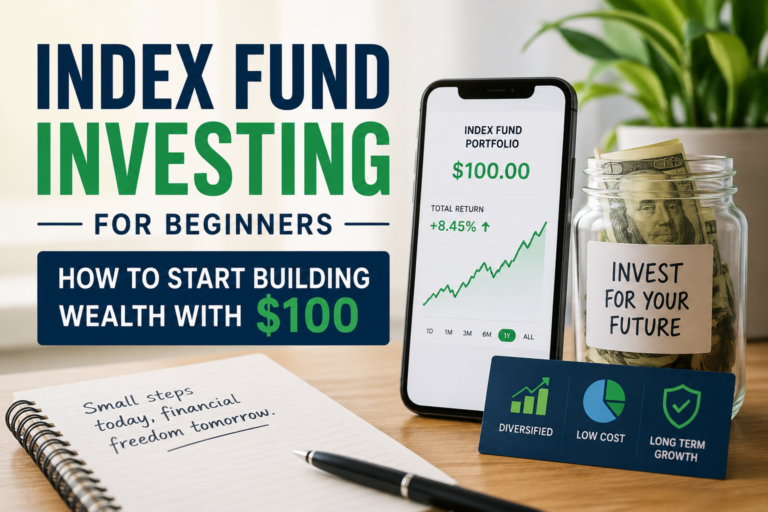
This is where index funds become remarkably accessible. Fidelity offers index funds with no minimum investment at all. Vanguard requires as little as $1 for its ETFs. Many brokerages offer fractional shares, meaning you can invest any dollar amount regardless of the share price. You do not need thousands of dollars to start — you can begin with whatever you have.
The Power of Compound Growth
The real magic of index fund investing comes from compound growth over time. If you invest $500 per month in a total stock market index fund and earn an average annual return of 8% — close to the historical average — here is what you would have: after 10 years, approximately $91,000. After 20 years, approximately $294,000. After 30 years, approximately $745,000. Your total investment over 30 years would have been $180,000. Compound growth created the remaining $565,000.
Conclusion
An index fund is the simplest, most cost-effective way for most people to participate in long-term market growth. They require no expertise to use effectively, cost almost nothing to own, and have a historical track record that outperforms the vast majority of professional fund managers. Continue with How to Start Investing in Index Funds and Best Index Funds for Beginners.