Index Fund Investing for Beginners: How to Start Building Wealth With $100
Index Fund Investing for Beginners: How to Start Building Wealth With $100
What if you could invest like the world’s most successful investors without spending hours researching stocks, paying high fees, or needing expert knowledge? Index fund investing makes this possible — and it is the strategy that Warren Buffett has famously recommended for the vast majority of ordinary investors.
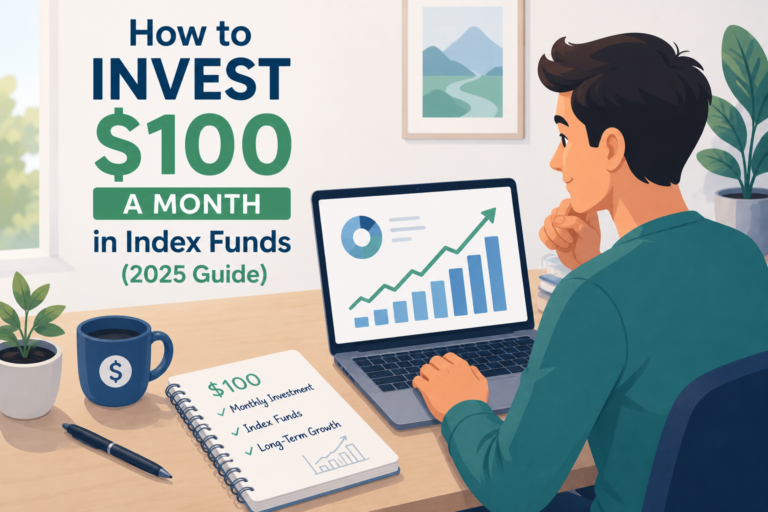
In this beginner’s guide, you will learn exactly what index funds are, why they consistently outperform actively managed funds, and how to start investing with as little as $100 today.
What Is an Index Fund?
An index fund is a type of investment fund that tracks a specific market index — a list of stocks or bonds that represents a particular segment of the financial market. The most famous index is the S&P 500, which tracks the 500 largest publicly traded companies in the United States.
When you buy shares of an S&P 500 index fund, you are essentially buying tiny pieces of all 500 companies at once — Apple, Microsoft, Amazon, Tesla, JPMorgan, and 495 others. This instant diversification is one of the key advantages of index funds.
Index funds are passively managed, meaning a fund manager does not pick and choose stocks. The fund simply follows its index. Because there is no active management, fees are extremely low compared to actively managed mutual funds.
Why Index Funds Beat Most Active Investors
This is one of the most important facts in investing: over any 15-year period, approximately 90% of actively managed funds underperform their benchmark index. This means that most professional stock pickers, with all their research and expertise, fail to beat the market over time.
Why? Because markets are highly efficient. Stock prices already reflect all publicly available information. Finding stocks that are truly undervalued is extremely difficult, even for professionals. After subtracting high management fees (often 1% to 2% per year), active funds almost never beat low-cost index funds.
A 1% annual fee difference might sound small, but over 30 years it compounds into a massive difference. A $10,000 investment growing at 8% annually for 30 years becomes $100,627 in a low-cost index fund (0.03% fee). The same investment in a high-fee active fund charging 1% annually becomes only $74,352. That 1% fee cost you over $26,000.
Types of Index Funds
S&P 500 Index Funds: Track the 500 largest US companies. The most popular starting point for beginning investors. Examples: Vanguard S&P 500 ETF (VOO), Fidelity 500 Index Fund (FXAIX), iShares Core S&P 500 ETF (IVV).
Total Market Index Funds: Track the entire US stock market, including small and mid-size companies in addition to large caps. Offers broader diversification than an S&P 500 fund. Examples: Vanguard Total Stock Market ETF (VTI), Fidelity Total Market Index Fund (FSKAX).
International Index Funds: Track stocks in developed or emerging markets outside the US. Adding international exposure reduces geographic risk. Examples: Vanguard Total International Stock ETF (VXUS), Fidelity International Index Fund (FSPSX).
Bond Index Funds: Track bonds rather than stocks. Less volatile than stock funds and provide stability to a portfolio. Examples: Vanguard Total Bond Market ETF (BND), iShares Core US Aggregate Bond ETF (AGG).
Target Date Funds: All-in-one funds that automatically adjust the mix of stocks and bonds as you approach your target retirement year. Ideal for hands-off investors. Examples: Vanguard Target Retirement 2050 Fund, Fidelity Freedom Index 2055 Fund.
How to Start Investing in Index Funds: Step by Step
Step 1: Choose an Investment Account Type
Before buying index funds, you need an investment account. The type you choose affects your taxes:
Roth IRA: Contributions are made with after-tax dollars, but your investments grow tax-free and withdrawals in retirement are completely tax-free. Maximum contribution in 2026 is $7,000 ($8,000 if age 50 or older). Best choice for most beginners if you expect to be in a higher tax bracket in retirement.
Traditional IRA: Contributions may be tax-deductible (reducing your current tax bill), and the money grows tax-deferred. You pay taxes when you withdraw in retirement. Same contribution limits as Roth IRA.
401(k): If your employer offers a 401(k) with a company match, always contribute at least enough to get the full match. That match is an immediate 50% to 100% return on your investment — nothing else comes close.
Taxable Brokerage Account: No special tax advantages, but no restrictions on contributions or withdrawals. Good once you have maxed out your tax-advantaged accounts.
Step 2: Choose a Brokerage
All major brokerages now offer commission-free trading and no account minimums. Top choices for beginners include:
Fidelity: Excellent for beginners. No account minimums, no commissions, fractional shares available (you can buy $1 of any stock or ETF), and outstanding customer service. Their index funds have some of the lowest expense ratios in the industry, including ZERO fee index funds.
Vanguard: The pioneer of low-cost index investing. Known for investor-owned structure that keeps costs low. Slightly less user-friendly interface than Fidelity but excellent funds.
Charles Schwab: No minimums, fractional shares, and a wide selection of low-cost index funds. Strong mobile app and customer service.
M1 Finance: Unique “pie” investing model that lets you set target allocations and automatically rebalances. Great for automated, hands-off investing.
Step 3: Choose Your Index Funds
For most beginners, a simple two-fund or three-fund portfolio provides excellent diversification at rock-bottom cost:
Two-fund portfolio: 80% Total US Stock Market (VTI or FSKAX) + 20% Total International (VXUS or FSPSX). Simple, diversified, and incredibly cheap.
Three-fund portfolio: 60% Total US Stock Market + 20% Total International + 20% Total Bond Market. Adding bonds reduces volatility for investors closer to needing the money.
Look for funds with expense ratios under 0.10%. Many Vanguard and Fidelity index funds charge as little as 0.03% to 0.00%.
Step 4: Set Up Automatic Contributions
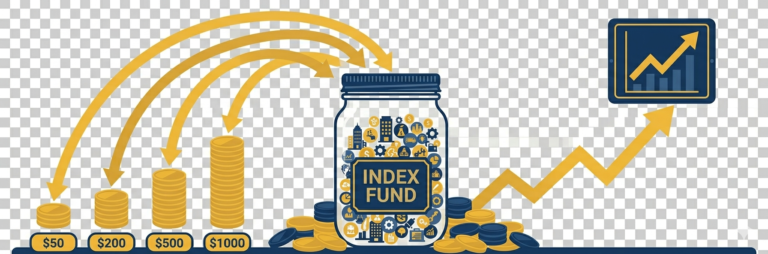
The single most powerful habit in investing is automatic, consistent contributions — often called dollar-cost averaging. Set up automatic monthly transfers from your bank account to your investment account and automatically invest in your chosen funds.
This approach removes emotion from investing. You buy more shares when prices are low and fewer when prices are high, averaging out your cost over time. You also remove the temptation to time the market, which research consistently shows is nearly impossible even for professionals.
How Much Should You Invest?
The honest answer: as much as you can consistently invest over a long period of time. But even small amounts matter enormously when invested early.
Investing $100 per month starting at age 25, assuming 8% annual returns, grows to approximately $351,000 by age 65. Wait until 35 to start and the same $100/month investment grows to only $150,000 — less than half, despite only 10 fewer years of investing. This is the magic of compound interest.
If $100/month is not feasible right now, start with $25 or even $10/month. The habit of investing matters more than the amount in the early years.
Common Index Fund Investing Mistakes to Avoid
Checking your portfolio every day and reacting to short-term market movements is one of the most damaging behaviors for long-term investors. Markets fluctuate constantly, but the long-term trend over any 20-year period in US history has been upward.
Selling during market crashes is the other critical mistake. Every major market crash in history has eventually been followed by a recovery to new highs. Investors who sold during the 2008 financial crisis or the 2020 COVID crash locked in their losses and missed massive recoveries.
Chasing past performance — buying funds because they performed well recently — is also a trap. Past performance does not predict future returns, and last year’s top performers are often next year’s laggards.
Start Your Index Fund Journey Today
Index fund investing is not exciting. It will not make you rich overnight. But it is the most reliable, evidence-backed way for ordinary people to build significant wealth over time. Open your account today, set up automatic contributions, and let compound interest do its work. Time in the market beats timing the market — every time.