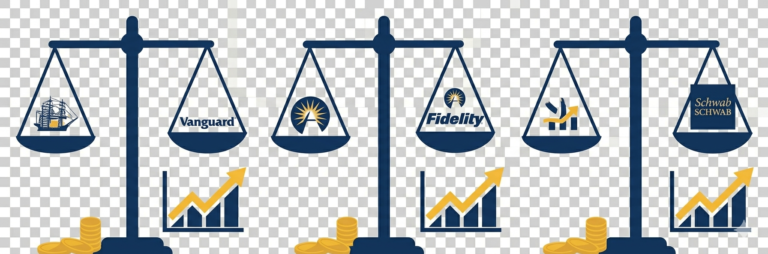

Vanguard vs Fidelity vs Schwab: Which Brokerage Is Best in 2026?
If you are looking to open a brokerage account for index fund investing, you have almost certainly narrowed your choices to Vanguard, Fidelity, and Schwab. This is a good shortlist. All three are legitimate, well-capitalized, low-cost institutions with decades of track records. You will not make a catastrophically wrong choice with any of them.
But the differences between them are real, and for the right investor profile, those differences matter. This guide goes deeper than the standard comparisons to help you choose the brokerage that actually fits how you invest and what you need.
Vanguard: The Index Fund Pioneer
Vanguard invented the index fund for retail investors. John Bogle launched the first publicly available index mutual fund in 1976 and built a company culture around one idea: that low-cost, passive investing beats active management for most investors over long time horizons. Decades of data have proven him right.
Vanguard’s unique ownership structure distinguishes it from every other major brokerage. The funds own the company, which means the fund shareholders — the investors — effectively own Vanguard. There are no external shareholders demanding profit maximization. Vanguard’s interest is structurally aligned with its investors in a way that no publicly traded competitor can claim. This is why expense ratios at Vanguard tend to be at or near the industry’s lowest.
Key Vanguard funds for index investors: VTSAX (Total Stock Market Index, expense ratio 0.04%), VTIAX (Total International Stock Index, 0.11%), VBTLX (Total Bond Market Index, 0.05%). ETF equivalents VTI, VXUS, and BND are available commission-free.
Vanguard’s limitations are real. The trading platform and mobile app are noticeably behind Fidelity and Schwab in terms of design and functionality. Some mutual funds have minimum investment requirements (typically $3,000). Customer service wait times have historically been longer than competitors. For buy-and-hold investors who check their accounts infrequently, these limitations matter less. For active users who want a polished experience, they are a genuine friction.
Fidelity: Best Overall for Most Investors
Fidelity has made a strong case for best overall brokerage in 2026, particularly for new and intermediate investors. The combination of zero-expense-ratio index funds, no account minimums, fractional share investing, and a well-designed platform is difficult to match.
Fidelity’s zero expense ratio funds — FZROX (Zero Total Market Index) and FZILX (Zero International Index) — are the lowest cost index funds available anywhere. An expense ratio of 0.00% means you pay nothing in management fees. Over 30 years on a $500,000 portfolio, the difference between 0.00% and even 0.03% (Vanguard’s rate) compounds to thousands of dollars. In practice, the difference at lower balances and shorter time horizons is minimal, but the principle is right.
The trade-off: Fidelity’s zero expense ratio funds are proprietary and cannot be transferred in-kind to another brokerage. If you ever want to move your account, you would need to sell these funds and repurchase equivalent funds at the new brokerage — a taxable event in a taxable account. Fidelity’s standard index funds (FSKAX, FTIHX) have expense ratios of 0.015% and can be transferred, making them the better choice if you value portability.
Fidelity’s platform and mobile app are genuinely excellent. Research tools, educational resources, and the overall user experience are best-in-class among the three brokerages. Customer service is fast and knowledgeable. For most investors — particularly beginners who want a well-designed, full-featured experience — Fidelity is the strongest recommendation in 2026.
Schwab: Best for Combined Banking and Investing
Charles Schwab is the largest retail brokerage by assets and offers a compelling full-service platform that integrates investing with banking in a way that Vanguard and Fidelity do not match.
Schwab’s index fund lineup is competitive: SWTSX (Total Stock Market Index, 0.03%), SWISX (International Index, 0.06%), SWAGX (Aggregate Bond Index, 0.04%). All commission-free with no minimums.
Where Schwab differentiates most strongly is its integrated banking offering. The Schwab Bank High Yield Investor Checking account has no fees, no minimums, and reimburses all ATM fees worldwide — an excellent feature for frequent travelers. Having brokerage and banking at the same institution simplifies cash management, transfers, and tax reporting. The Schwab debit card is among the most travel-friendly available from any financial institution.
Schwab’s customer service is consistently rated as the best among the three — lowest wait times, most knowledgeable representatives, and branch locations in major cities for clients who prefer in-person service. For investors who value human accessibility, this matters.
The Expense Ratio Reality Check
All three brokerages offer index funds with expense ratios between 0.00% and 0.15%. On a $10,000 portfolio, the difference between 0.03% and 0.06% is $3 per year. This is genuinely irrelevant at most portfolio sizes. The choice between brokerages should not hinge on marginal expense ratio differences — it should hinge on platform experience, features, and what services matter to you.
Expense ratios matter at scale. On a $1 million portfolio, the difference between 0.04% and 0.10% is $600 per year and compounds significantly over decades. At that scale, Vanguard or Fidelity’s lowest-cost options have meaningful advantage. For most investors building toward that number, the choice matters less now than developing the habit of consistent investing.
Which Should You Choose?
Choose Fidelity if you are new to investing, want the best platform experience, want fractional shares for small dollar amounts, or have no existing brokerage preference. It is the safest recommendation for most people in 2026.
Choose Vanguard if you are a dedicated buy-and-hold investor who cares deeply about structural alignment with investor interests, already holds Vanguard funds, or will invest at a scale where the lowest possible expense ratios have meaningful impact.
Choose Schwab if you want integrated banking and brokerage, travel frequently and value global ATM fee reimbursement, or want access to physical branch locations.
Get started with M1 Finance if you want automated portfolio management — set your target allocation and M1 automatically invests and rebalances with no manual trading required.