How Much to Invest in Index Funds: A Practical Guide for Every Income Level
One of the most common questions from new investors is: how much should I actually invest? The honest answer is: more than you think you can, less than you’re afraid of, and starting today rather than waiting for the “right” amount. This guide gives you concrete frameworks for every income level — from investing $50/month on a tight budget to maximizing contributions at higher incomes.
The Classic Framework: 15% of Gross Income
The most widely cited rule of thumb for retirement investing is 15% of gross income. This accounts for the fact that most people don’t start investing at 25, and includes any employer 401(k) match as part of the 15%. If your employer matches 5%, you contribute 10% and you’ve reached the 15% target together.
For someone earning $60,000/year, 15% is $9,000/year or $750/month. That’s a stretch for many people — which is why the rule is better treated as a target to work toward rather than a starting requirement.
How Much to Invest by Income Level
Income Under $40,000/Year
At this income level, even small amounts matter enormously thanks to time and compounding. Priority order:
- Contribute enough to your 401(k) to capture the full employer match (free money)
- Build a $1,000–$2,000 emergency fund before investing aggressively
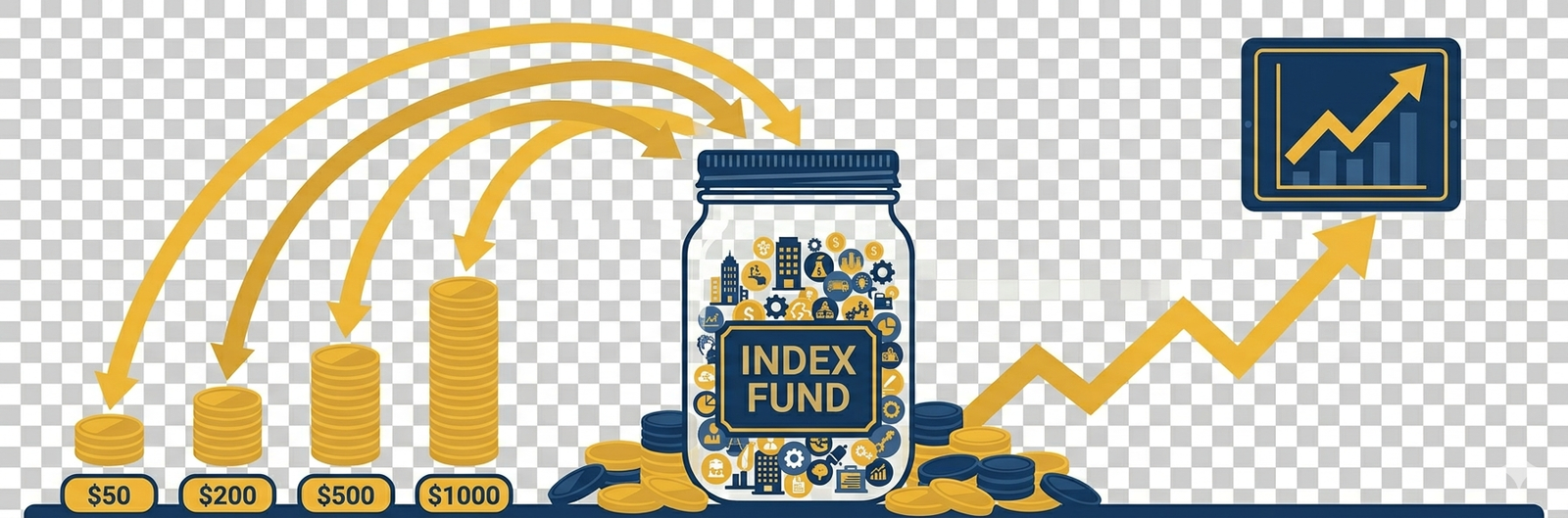
- Open a Roth IRA and invest $50–$200/month depending on budget
$50/month invested from age 22 at historical returns: approximately $340,000 by age 65. Start small and increase by $25/month whenever you get a raise.
Income $40,000–$80,000/Year
Target: 10–15% of gross income. At $60,000, that’s $500–$750/month.
- Capture full 401(k) employer match
- Max Roth IRA ($7,000/year = $583/month)
- Any additional to taxable brokerage or increase 401(k) beyond match
Income $80,000–$150,000/Year
Target: 15–20% of gross income. At $100,000, that’s $1,250–$1,667/month. Priority: max 401(k) ($23,500/year in 2026) + max Roth IRA ($7,000/year) + taxable brokerage for overflow.
Income Over $150,000/Year
Max all tax-advantaged accounts first (401k + IRA + HSA if eligible). Beyond that, taxable brokerage accounts for additional investing. Consider backdoor Roth IRA contributions if income exceeds Roth IRA income limits. Consult a fee-only financial advisor for tax optimization at this income level.
What to Do If You Can Only Invest a Little
Start with whatever you can — even $25 or $50/month. The psychological value of starting cannot be overstated. Once you’re investing, you’ll naturally look for ways to increase the amount. Every time you get a raise, automatically increase your contribution by half the raise amount before you adjust your lifestyle to the new income. If you get a $300/month raise, increase your investment contribution by $150.
For step-by-step account setup, see how to invest in index funds. For the strategy behind consistent monthly investing, see our guide on dollar cost averaging.
The Order of Operations for Investing
- Build emergency fund ($1,000 minimum, 3–6 months expenses ideally)
- Capture full 401(k) employer match (guaranteed 50–100% return)
- Pay off high-interest debt (anything above ~7% APR)
- Max Roth IRA ($7,000/year for 2026)
- Max 401(k) beyond employer match ($23,500/year limit)
- Max HSA if eligible ($4,300 individual / $8,550 family)
- Taxable brokerage for additional investing
FAQ
Is $500/month enough to invest?
$500/month invested from age 30 at historical 10.5% annual returns grows to approximately $1.5 million by age 65. Yes, $500/month is absolutely enough to build significant wealth. The question isn’t whether it’s “enough” — it’s whether you can maintain that consistently.
Should I invest a lump sum or dollar cost average?
Research shows that lump sum investing (investing immediately when money is available) outperforms dollar cost averaging about 2/3 of the time over the long term, simply because markets go up more often than down. However, the psychological benefit of spreading investments over time — avoiding the regret of a bad entry point — makes dollar cost averaging the right behavioral choice for most investors. See our dollar cost averaging guide for the full analysis.